Australian Compliance Manager's Guide to the Digital Assets Framework
What Changed • What to Do • When to Do It • What It Costs

Australia’s digital asset sector has undergone a fundamental regulatory reset. Under the previous framework, a digital currency exchange needed only to register with AUSTRAC and comply with AML/ CTF obligations a “register and operate” model that treated most crypto firms as lying outside the financial services perimeter. That position has been comprehensively overturned.
The Corporations Amendment (Digital Assets Framework) Bill 2025, which passed in April 2026, creates the new Digital Asset Platform (DAP) and Tokenized Custody Platform (TCP) licensing categories and compels exchanges, custodians and wallet providers to hold an Australian Financial Services Licence (AFSL) issued by ASIC.
Together with the Payments System Modernization Bill (September 2025) capturing stablecoin arrangements, and ASIC’s clear guidance in Info Sheet 225 (October 2025) that many tokens and stablecoins are financial products, compliance managers now face dual‑regulator oversight (ASIC and AUSTRAC), fiduciary‑grade custody and client‑asset rules, and conduct obligations that have no precedent in the local industry. The old register‑and‑operate paradigm is dead; organisations that treat this as a mere AUSTRAC update will fail.
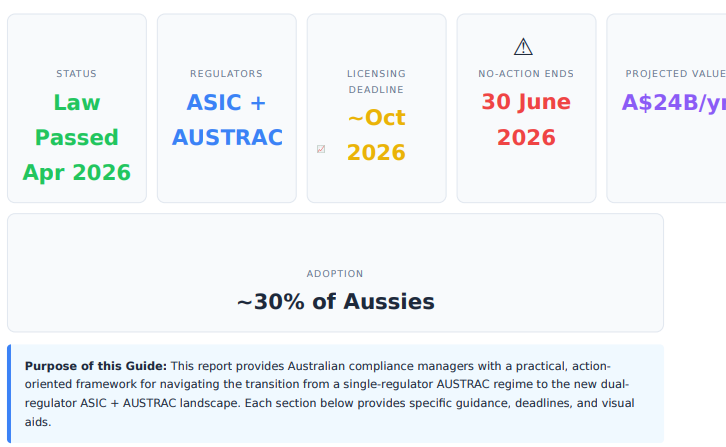
The transition timetable leaves no room for delay. ASIC’s no‑action relief for existing crypto businesses expires on 30 June 2026, after which unlicensed activity exposes firms to enforcement risk.
Preparing and lodging a full AFSL application routinely takes three to six months, meaning operators that have not yet commenced scoping and documentation are already dangerously behind.
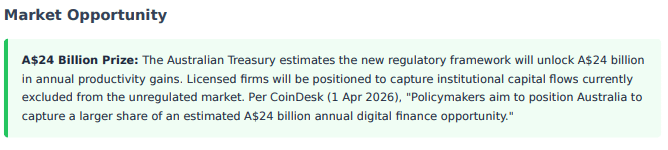
The Government estimates a well‑regulated digital asset sector can deliver an A$24 billion annual productivity boost a prize that will flow to firms that achieve licensing, not those caught in the compliance bottleneck. ASIC’s 2026 Key Issues Outlook has flagged crypto as a “regulatory perimeter” risk, and AUSTRAC’s DCE registration requirement continues in parallel. With the full licensing deadline expected around October 2026, the window to design, resource and embed compliant systems is shrinking rapidly.
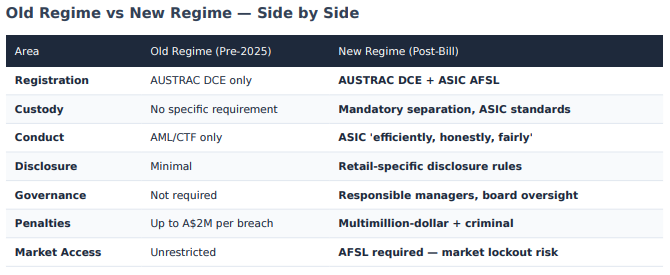
The Regulatory Shift - Old vs New
Before the 2025 Bill, compliance managers navigated a grey zone: AUSTRAC registration alone sufficed, but ASIC’s looming perimeter risk and expiring no-action relief created uncertainty over whether tokens were financial products. The new regime imposes a dual-regulator burden AUSTRAC plus a full AFSL for digital asset platforms and custody transforming crypto from a loosely supervised sector into a licensed, prudentially overseen industry.
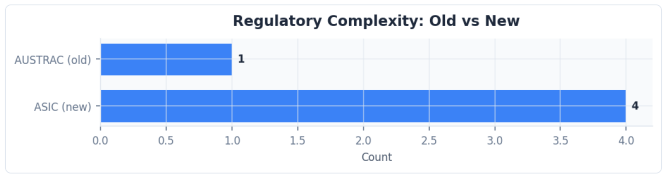
Regulatory Complexity Increase
The number of distinct regulatory obligations has expanded significantly. The chart below illustrates the relative compliance burden before and after the new framework:
Key Insight:
The shift from AUSTRAC-only to AUSTRAC + ASIC creates a dual-regulator compliance burden that most Australian crypto businesses have never managed. ASIC's standards around custody, disclosure, governance, and conduct are fundamentally different from AUSTRAC's AML/CTF focus. Compliance managers need capability in both domains.
Licensing Pathways & Deadlines
Compliance managers must first assess whether they operate a Digital Asset Platform (DAP) for exchange/trading or a Tokenized Custody Platform (TCP) for holding assets, as both require an AFSL (3– 6 month application timeline).
Ask:
Do we custody tokens? If yes, TCP applies; if we facilitate trading without custody, DAP applies.
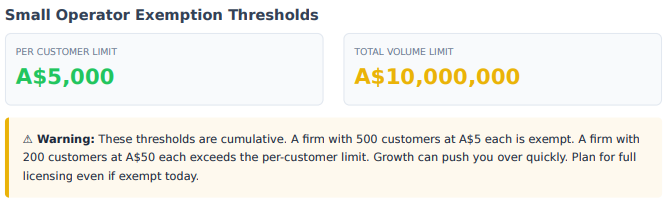
Check if you qualify for the small operator exemption under $5,000 per client and $10 million total volume otherwise full licensing is mandatory.
Consider AUSTRAC DCE registration and the coming October 2026 deadline, as no-action relief expires June 2026.
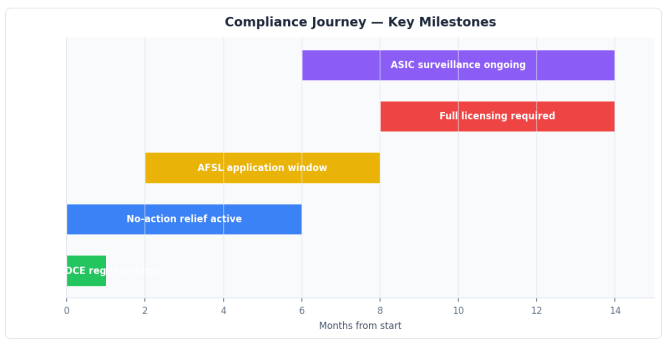
Compliance Journey Timeline
The critical path from the current no-action relief period through full ASIC regulation:
Urgency Breakdown
The urgency confronting Australian digital asset compliance managers is immediate and unforgiving. The ASIC no-action relief position, which has permitted unlicensed firms to operate while assessing their obligations, expires on 30 June 2026. That is a matter of days, not months. The industry has widely misinterpreted what it means to have an application “in progress.” It is not a holding email or an expression of intent lodged with ASIC.
It means a substantially complete AFSL application package containing:
a detailed business plan describing the nature and scale of digital asset activities;
a comprehensive compliance manual with policies covering conflicts of interest, custody, trading, and market integrity;
a risk management framework identifying operational, technological, and financial risks specific to crypto;
evidence of at least one responsible manager meeting ASIC’s organisational competence requirements; and
auditable financial resource calculations demonstrating adequate capital and liquidity.
Preparing these materials to a standard that survives ASIC scrutiny typically takes three to six months. Any firm that has not commenced this work in earnest is already behind.
The consequence of missing the 30 June window (now extended to September 30th) is not merely technical non-compliance it is operating in a regulatory void where ASIC has explicitly signalled it will treat crypto as a perimeter risk, with enforcement action, customer remediation orders, and potential director liability all in play. Beyond the June cliff lies the October 2026 hard deadline, after which carrying on a digital asset platform or tokenised custody business without an AFSL becomes unlawful. There is no further transitional period and no expectation of administrative forbearance.
The small operator exemption capped at $5,000 per customer and $10 million in total aggregate volume provides a narrow and inherently fragile safe harbour. Firms relying on it must recognise that a single bull market cycle, a successful marketing campaign, or an influx of memecoin-driven retail volume can breach those thresholds within weeks. The exemption is not a licence; it is a temporary concession that disappears the moment a firm exceeds the limits, at which point the full weight of the law applies retrospectively to unlicensed conduct.
The prudent course is to plan and resource for full AFSL authorisation now, regardless of current size. The government’s alignment of the regime with Singapore and Hong Kong frameworks signals that Australia intends to be a serious, supervised market not an offshore backwater.
Firms that miss the October deadline will be locked out of the Australian market entirely, unable to onboard customers, maintain banking relationships, or contract with payment rails. In an environment where debanking of crypto firms is already an acknowledged structural problem and AUSTRAC is seeking expanded powers to restrict crypto ATMs, a valid AFSL is the only durable defence against being excluded from the financial system.
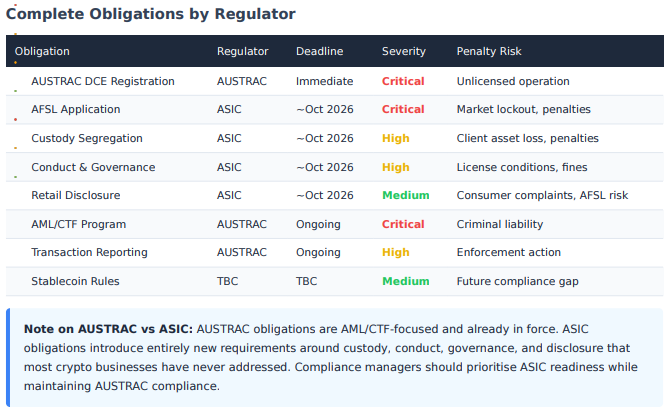
Regulator Obligations Matrix
The new regulatory framework imposes layered obligations on digital asset platforms. AUSTRAC’s existing AML/CTF registration remains, while ASIC now separately administers licensing, conduct, custody and disclosure requirements under the AFSL regime. Some duties overlap between the two regulators; others are entirely novel. Compliance managers must systematically map both sets of requirements, identify gaps, and implement controls to satisfy dual-regulator oversight. The most significant shifts include:
custody segregation client assets must be legally and operationally ringfenced from firm assets;
explicit conduct obligations ASIC’s ‘efficiently, honestly and fairly’ standard now directly applies;
tailored retail disclosure rules for crypto products; and
strengthened governance, requiring responsible managers, board oversight and dedicated risk committees.
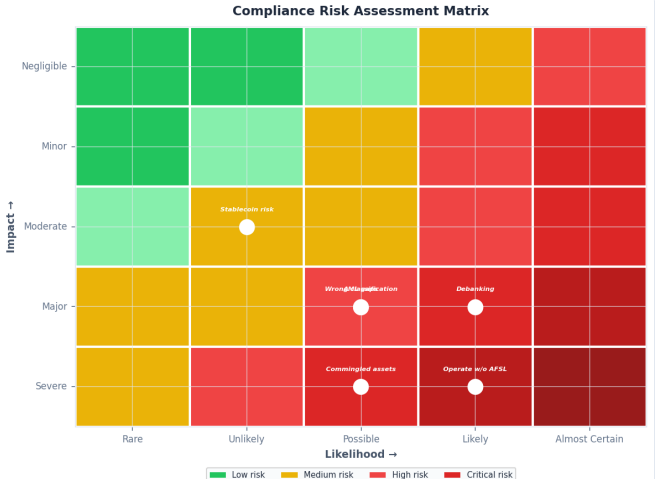
Risk Assessment & Mitigation
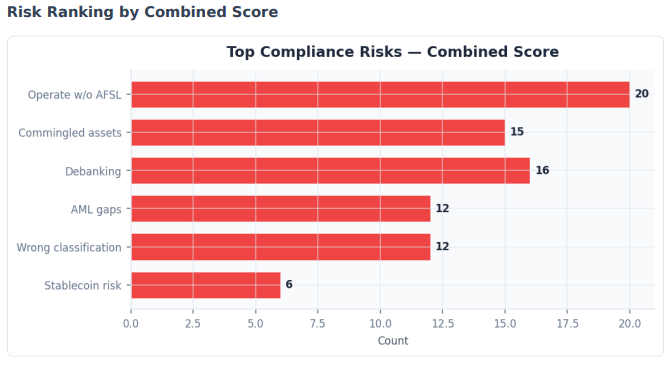
Compliance managers must navigate Australia’s dual-regulator regime amid tight licensing deadlines and debanking pressures. Our risk assessment maps key exposures by likelihood and impact, using the heatmap to prioritise threats from ASIC enforcement and AUSTRAC restrictions to non‑compliance with the Digital Assets Framework so you can focus resources where they matter most.
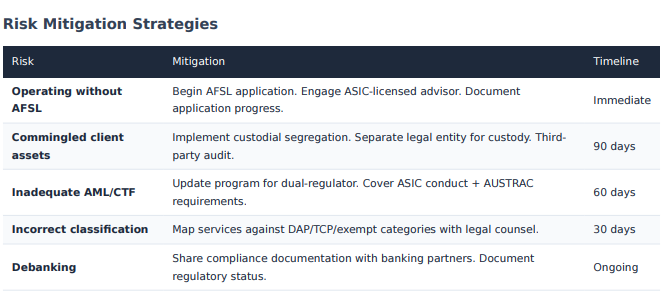
Enforcement & Compliance Landscape
ASIC’s 2026 Key Issues Outlook identifies crypto as a “regulatory perimeter” risk—firms deliberately structuring offerings to fall outside existing laws. With the April 2026 passage of the Digital Assets Framework Bill and ASIC Info Sheet 225 (October 2025) classifying many tokens as financial products, ASIC has signalled intensified enforcement against unlicensed advice and misleading conduct ahead of the October 2026 licensing deadline.
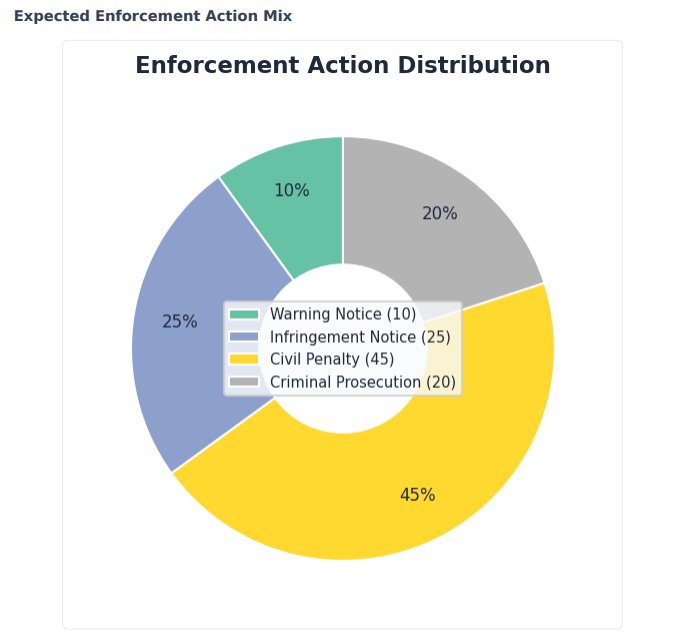
AUSTRAC’s proposed powers to restrict crypto ATMs target scams and money laundering, building on the existing DCE registration requirement under the dual-regulator regime. The FSB’s October 2024 critique of the sector’s immature compliance culture underscores the need for vigilance.
ASIC's Stated Position (Key Issues Outlook 2026): "Fast-growing crypto, payments, and AI players operating at the edge of regulation are exposing consumers to unlicensed advice and misleading conduct." ASIC Key Issues Outlook 2026. This language signals that enforcement is not theoretical. ASIC has put the industry on notice.
Cost-Benefit Analysis
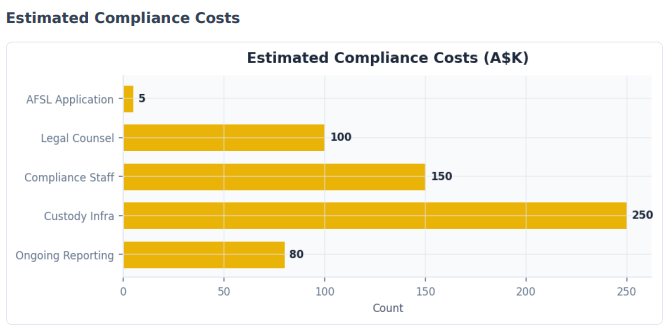
For Australian digital asset businesses, the direct and indirect costs of seeking an Australian Financial Services Licence are substantial. ASIC’s application fee sits between $2,000 and $5,000, with additional annual levies scaled to platform size, but the real expense lies in preparation. Engaging specialist legal counsel to navigate the Digital Asset Platform or Tokenized Custody Platform categories, draft proof of competence, and demonstrate adequate risk and custody arrangements typically costs $50,000 to $150,000.
Hiring a dedicated compliance officer or retaining an external expert adds $80,000 to $200,000 per year. Building or upgrading custody infrastructure to meet the new statutory standards for safeguarding client assets can easily run from $50,000 for smaller operators to over $500,000 for firms needing cold-storage segregation and multi-signature controls.
Beyond these upfront investments, ongoing regulatory reporting, independent audits, and dual regulation obligations under AUSTRAC’s DCE registration impose permanent operational overheads that must be budgeted for annually, particularly while the sector, as the Financial Stability Board noted, still lacks a mature compliance culture.
These costs must be weighed against tangible and strategic benefits. The Treasury projects a $24 billion annual productivity boost flowing from the clarified framework, and industry experience in comparable jurisdictions indicates that licensed operators capture a disproportionate share of the market as unlicensed competitors are forced to exit or are blocked by banking partners. Institutional capital, which has largely sat on the sidelines, almost universally requires a regulated, AFSL-holding counterparty for execution and custody.
The new regime directly addresses the industry’s debanking problem: with a clear licence in place, maintaining banking relationships should become simpler because financial institutions gain the regulatory certainty they n
eed to serve crypto firms. Conversely, the cost of non-compliance is catastrophic a total loss of the Australian revenue base through market lockout, multimillion-dollar ASIC penalties, and reputational damage that would cripple client acquisition and future business. For a compliance manager, early licensing therefore represents not a discretionary expense but a competitive moat that turns regulatory alignment into a long-term advantage.
Key Findings & Recommendations
Key Findings
Australia has shifted from a largely unregulated crypto environment to a comprehensive statutory licensing regime, fundamentally reclassifying digital asset platforms and custody services as regulated financial entities for the first time.
Compliance managers face an acute timeline crunch as the ASIC no-action relief expires on June 30, 2026, with full licensing required by approximately October 2026, leaving a narrow window to build or overhaul compliance frameworks.
The dual-regulator regime creates layered complexity, requiring platforms to simultaneously navigate ASIC's AFSL obligations for financial product conduct and AUSTRAC's DCE registration for anti-money laundering compliance.
ASIC has explicitly designated crypto as a 'regulatory perimeter' risk for 2026, signaling that enforcement action will target unlicensed operators and firms failing to meet the new standards once transitional relief ends.
The government's projection of an A$24 billion annual productivity boost, combined with formal regulatory recognition, creates a significant market opportunity for compliant platforms to capture institutional and retail demand in a now-legitimized sector

References & Data Sources
This report aggregates data from Australian regulatory authorities, news publications, and industry analysis. Sources cited include:
Primary Sources
[1] Australia Targets $24B Boost With Tough New Crypto Crackdown. CryptoNews.com.au https://cryptonews.com.au/news/australia-targets-24b-boost-with-tough-new-crypto-crackdown-131944/
[2] Australian Senate committee backs new crypto platform licensing bill. Cointelegraph https://cointelegraph.com/news/australian-senate-committee-backs-new-crypto-bill
[3] Australia passes crypto regulation requiring exchanges to obtain financial services licenses. CoinDesk https://www.coindesk.com/policy/2026/04/01/australia-passes-crypto-licensing-bill
[4] Australia Puts Crypto Oversight Gaps on 2026 Risk List. Decrypt https://decrypt.co/355986/australia-crypto-oversight-gaps-2026-risk-list
[5] APAC's Digital Currency Strategies Diverge CBDC vs Stablecoin. BeInCrypto https://beincrypto.com/apac-digital-currency-strategies-diverge-cbdc-stablecoin/
[6] Australia's ASIC flags crypto as 'regulatory perimeter' risk. Cointelegraph https://cointelegraph.com/news/asic-crypto-regulatory-perimeter-2026-outlook
[7] Crypto Adoption in Australia Stalls as Trust Drops. Decrypt https://decrypt.co/345576/crypto-adoption-australia-stalls-trust-drops-labors-push-regulation
[8] ASIC Info Sheet 225 Digital Assets. ASIC https://asic.gov.au/regulatory-resources/digital-assets
Data Notes
Data compiled from multiple public sources as of 22 June 2026
Regulatory status reflects publicly announced positions as of report date
Cost estimates are ballpark figures based on industry averages
This report does not constitute legal advice
Mirror AI Compliance Intelligence — mirror.glasslane.io